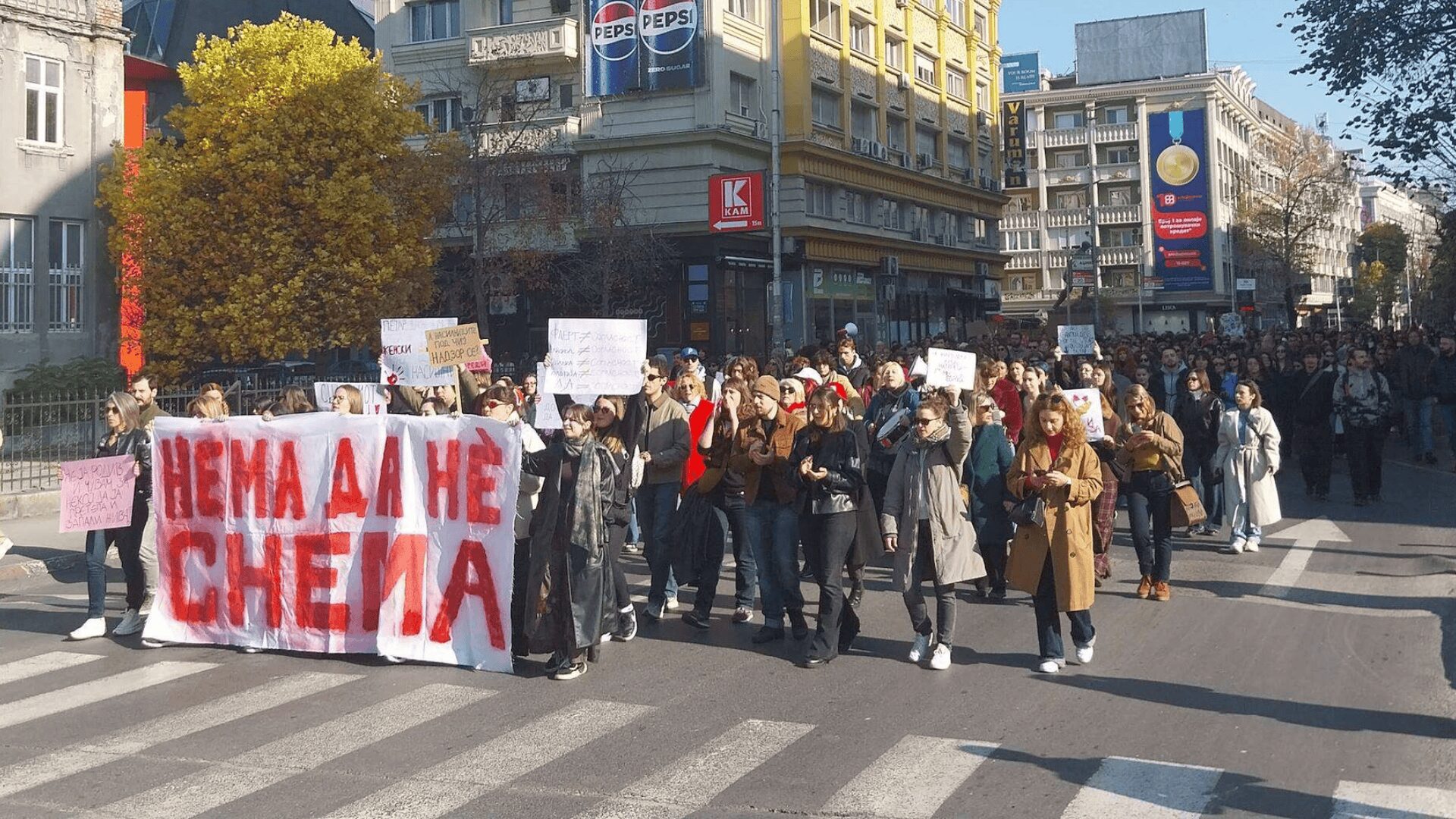
In a year with seven femicides, three civil society organizations are calling on institutions to stop holding ceremonies and start making concrete decisions. Among their six demands is the withdrawal of the changes to sex education in schools, which the Ministry of Education and Science (MoES) reinstated without gender equality, without contraception and without any content on sexual diversity or homophobia.
The demands were submitted by the Network for Protection against Discrimination, the National Network to End Violence against Women and Domestic Violence, and the Platform for Gender Equality. They are inviting citizens to support the protest on November 25, the International Day for the Elimination of Violence against Women.
The changes affect LGBTQ+ students in particular. The MARGINI Coalition warns that without this content, school remains an unsafe place for them. According to the research they cite, almost 37% of students reported that peer violence based on sexual orientation or gender identity had occurred at their school, and 63% of LGBTIQ students hide their identity at school.
In their statement, the organizations say they cannot allow another campaign of conferences, ceremonies and symbolic gestures while women continue to be killed, even in cases where the violence had been reported beforehand. They are calling for a moratorium on protocol events by institutions during the 16 Days of Activism, but not on civic activism.
The organizations’ six demands
- Adoption of the amendments to the Law on Prevention and Protection from Violence against Women and Domestic Violence, submitted to Parliament on August 26, by December 10 at the latest.
- Adoption of the package of amendments to eight laws, including those on the police and the family, for better coordination between the police, social protection and the judiciary.
- At least 200 million denars in the 2027 budget for specialized services for victims and programs for perpetrators of violence.
- Adoption and publication of the conclusions of the parliamentary oversight hearing on gender based violence, with concrete deadlines and responsibilities.
- Withdrawal of the regressive changes in education: in the laws on primary education, the textbooks, the guidelines on protection from violence and the sex education program, which, in their view, have weakened protection from discrimination, gender equality and the prevention of violence.
- Individual and institutional accountability for all femicides, including the most recent case of a girl aged 17 from Bogdanci, with an independent review of how the institutions acted.
On December 10, when the campaign ends, the organizations say they do not want to count the events held and the photos published. They want to know which laws have been passed, how much funding has been secured, which measures have been taken and who has taken responsibility.
What was removed from the program: gender, contraception and references to homophobia
The previous Comprehensive Sexuality Education program was withdrawn at the beginning of September, just days after Bishop Jakov Stobiski, in an open letter, asked Minister Vesna Janevska to pull it. He criticized the minister for opposing the term “gender” while in opposition, and then, once in power, backing a program that contained it.
“Minister Janevska, withdraw this program of ideological indoctrination of our youth,” the bishop wrote in the open letter.
The minister withdrew the program for review, but a week later said she had read it herself and found nothing controversial. Even so, the program came back with changes precisely where the objections had been. It is now called “Health and Health Protection” and has the same number of classes and topics, but without some of the terms that explain forms of discrimination and violence.
The main changes:
- The topic “Gender and Gender Equality” is now simply “Equality.” The lesson on stereotypes, gender discrimination and sexism has become “Equality: stereotypes and prejudices, discrimination.”
- “Sexual and Reproductive Health” is now just “Reproductive Health.” From the two classes covering pregnancy and contraception, the term “contraception” has been removed.
- The topic “Sexual and Reproductive Rights” is now called “Rights and Responsibilities Related to Health,” and the content that explicitly mentioned sexual diversity and homophobia has been taken out. The lesson on discrimination and homophobia, respect for differences and standing up to discrimination has been narrowed down to “Discrimination: respect, equal treatment and opposing discrimination.”
So students will still learn about discrimination, stereotypes and violence, but without some of the concepts that help explain their forms and causes.
The ministry justifies the changes by pointing to an analysis of professional and public opinion, and denies that they were made in response to religious reactions.
“The changes to the curriculum of the elective subject in question were made after an analysis of public and professional opinion, including the views of representatives of the Chamber of Psychologists, and not on the basis of the opinion or reaction of representatives of any religious community,” the ministry told 360 Degrees.
According to the ministry, the substance of the subject remains the same, and the aim is to educate young people about protecting their personal health.
MARGINI: Schools are not safe for everyone, and MoES has removed the content on LGBT topics and homophobia
The MARGINI Coalition reacted in particular to the removal of content on sexual diversity and homophobia, saying the changes weaken the program’s role in preventing discrimination and violence against LGBTI young people.
“MoES owes the public an explanation of which professional findings this change was based on and how it contributes to the goals of education. School is not safe for everyone. We know this because we have documented it. Research shows that almost 37% of students reported that peer violence based on sexual orientation or gender identity had occurred at their school. In North Macedonia, 63% of LGBTIQ students hide their identity at school, and 61% of respondents said that LGBTIQ issues were never covered in their education,” MARGINI said.
According to the organization, instead of using this data to strengthen prevention policies, the ministry chose to remove from the program the content that deals directly with homophobia. MARGINI is calling for the return of the content on sexual diversity, homophobia, gender equality and sexual and reproductive rights. It also wants the professional assessments behind the changes to be published, confidential mechanisms for reporting homophobic and transphobic violence in schools, and the involvement of young people in shaping education policy.
“MoES must stop adapting education policy to prejudice,” the Coalition said in its statement.
Institute for Gender Studies: Students are left without the terminology to understand the problems
The Institute for Gender Studies at the Faculty of Philosophy in Skopje has asked MoES and the Bureau for Development of Education to restore the terms “gender,” “gender equality,” “gender roles,” “gender stereotypes” and “gender based violence” before the program is rolled out in secondary schools.
According to the Institute, the program contradicts itself: students are asked to explain the difference between the biological characteristics of sex and society’s expectations of how individuals should behave, yet the scientific term that explains this difference has been removed.
“A revision that answers the objection by deleting the term does not solve the problem, but passes it on to teachers and students, who are left without the terminology they need to explain the phenomena the program still asks them to analyze. The answer to the objection is a clear, accurate and age appropriate definition of the term within the program itself,” the Institute said in its statement.
They stress that the removed terminology is also used in the country’s legislation. The Law on Prevention and Protection from Discrimination lists sex, gender and gender identity as separate grounds of discrimination, and the term “gender based violence” is used in domestic legislation and in the Istanbul Convention.
Platform for Gender Equality: Inequality does not disappear when the word “gender” is deleted
The Platform describes the changes as part of a broader trend of pushing gender equality out of public policy and legislation.
“We do not see this decision as an isolated case, nor as a simple change of terminology. It is another step in the worrying trend of the institutional sidelining of gender equality from public policy and legislation, which we have been following in recent years,” the Platform said in its statement.
If the education system does not name these phenomena and does not help young people understand their causes, they say, it does not help overcome them but contributes to silence about them. The Platform is calling on MoES to review the program before it is implemented, to publish the professional arguments behind the changes, and to guarantee that education policy will not be changed under pressure from groups that oppose gender equality.
The EU mentions the case in its progress report
The European Commission mentions the case in its latest progress report. The report notes that the Constitutional Court has received two initiatives challenging the constitutionality of the 2025 changes to the education laws, which concern the removal of content on sexual and reproductive health and gender equality.
“The issue of the removal of content on sexual and reproductive health and gender equality from primary and secondary education remains to be addressed,” the report says.
Mollëkuqja.mk has previously reported on the withdrawal of Comprehensive Sexuality Education and on the concerns this decision raised among health professionals, psychologists and civil society organizations.
To recap, the Comprehensive Sexuality Education program was given the green light in 2019, and its pilot implementation began in 2021, in just three schools in Skopje and Tetovo. In one of them, the program was canceled because of pressure from parents.
Meanwhile, sex education is offered in many European countries, including the Netherlands, Sweden, Finland, Switzerland, Norway, Austria, Estonia, Portugal, Belgium, Ireland, Germany and the United Kingdom. In the region, Albania has included Comprehensive Sexuality Education in primary and secondary schools since 2012, and in Bosnia and Herzegovina it has been taught for several years as an elective subject in some cantons.