“Femicide has no ethnicity,” say activists and human rights organisations in North Macedonia, who are urging that the fight against violence against women should not be split along lines of language, ethnic background or the community a victim comes from. The calls come after high numbers of women killed in the country, deaths that experts classify as femicide, and after several severe cases within just a few days.
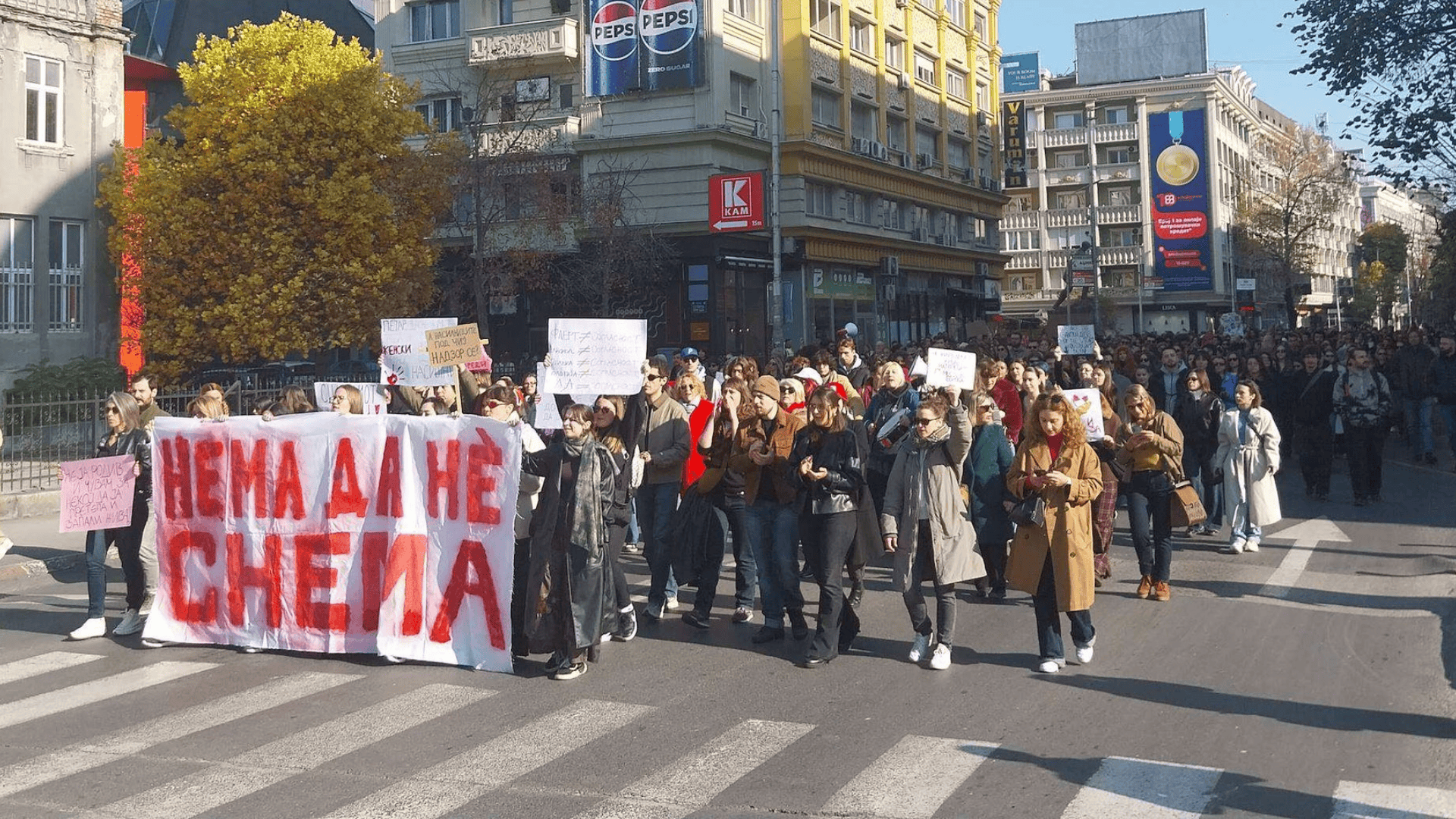
The killing of 17-year-old Biljana Kiriq from Bogdanci prompted strong reactions and reopened the debate over the responsibility of institutions to protect victims. Soon afterwards came two more cases. In Ohrid, a 26-year-old woman, Sara Gjeorgievska, was attacked and seriously injured, while the suspect was released under precautionary measures. In Bitola, a 21-year-old woman had reported long-term abuse and threats to kill her, yet the suspect escaped through a window at the police station. In Skopje, a protest march organised by the informal initiative “Not One More!” demanded accountability for institutional failures.
The Network for Protection against Discrimination, the Platform for Gender Equality and the National Network to End Violence against Women and Domestic Violence issued a joint response on how institutions are handling these cases, and Mollëkuqja has joined their demands. The response stresses that systemic responsibility does not cancel out individual responsibility, and it also criticises the public language of officials. According to them, when the prime minister calls domestic violence a “minor offence”, he downplays how serious it is.
What is being demanded of institutions
- An urgent request for detention in the Ohrid case, with a clearly reasoned legal basis, and an investigation into the possible involvement of other people.
- Urgently locating the suspect in Bitola and establishing who is responsible for his escape.
- A comprehensive review of the institutional failures that preceded the femicide in Bogdanci.
- Long-term protection and support for women exposed to violence.
- Legal changes without anti-gender conditions, sanctions for public messages that justify violence, and responsible media reporting.
Alarming figures on the killing of women
In North Macedonia, 26 women were killed between 2021 and 2025. In 2023 alone, 9 women lost their lives and, according to Eurostat data, that year the country had one of the highest femicide rates in Europe, at 6 cases per million inhabitants.
For a long time, the lack of a clear legal definition has made it hard to establish the exact number of cases. The Criminal Code does not use the term femicide explicitly, but in 2023 Article 123 was amended with paragraph 2-a, which punishes the killing of a woman, or of a girl up to the age of 18, as a result of gender-based violence.
Figures from the Ministry of Interior, cited in the European Commission’s latest report, show 5 femicide cases in 2023, 3 in 2024 and 6 in 2025. The same data show that police registered 5,300 reports of violence against women in 2023, 4,210 in 2024 and 5,436 in 2025. These numbers differ from the figures above, which shows how hard it is to count cases accurately.
What the EU report says
The problems raised by activists also appear, in more diplomatic language, in the European Commission’s latest report on North Macedonia, published last week. It describes gender-based violence, including domestic, psychological, economic and cyber violence, as well as femicide, as a serious human rights issue.
According to the report, the legal and institutional framework on gender equality and on combating gender-based violence is still incomplete, and implementation needs to improve. The Criminal Code amendments adopted in January strengthened the criminal-law response to domestic violence, but the legislation is still not fully aligned with the EU Directive on combating violence against women and domestic violence. Gaps remain, among them in the criminalisation of forced marriage and psychological violence. The Law on Gender Equality has still not been adopted, although the National Action Plan for Gender Equality 2025 to 2027 was adopted in January 2026.
The report also points to shortcomings in the reporting, investigation and prosecution of cases. Some specialised services for victims are not operating or do not meet the required standards, while a lack of staff and funding, and the unresolved licensing of civil society service providers, make their work harder. Access to justice remains limited, partly because of the high cost of court proceedings and the lack of free legal aid. The Commission also warns about anti-gender narratives, which are influencing political discussions and public debate, and about women human rights defenders, who face hate speech and threats, especially online. Among its recommendations for the coming year is to provide adequate support to women who have survived gender-based violence.
A problem that unites activists
Beyond laws and statistics, activists want violence against women not to be seen as the problem of a single community. In a society like North Macedonia’s, where ethnic differences often shape how public issues are handled, they are calling for this fight not to be split along ethnic lines but to become a shared effort.
Elena Dimushevska, chair of the National Network to End Violence against Women and Domestic Violence, tells Mollëkuqja that unity among activists is essential, but that this fight cannot be left to them alone.
“Violence against women does not recognise ethnicity, gender, age or social status, so the response must also be shared, built on solidarity and coordinated. But this fight is not only the task of activists: it needs the support of all citizens, because every community has a responsibility to stand up against violence and to defend the right to life and dignity,” says Dimushevska.
She adds that cooperation between different groups is essential in order to demand institutional accountability, better policies and systemic prevention.
“Building this front takes trust, continuous communication, the involvement of all communities and a clear commitment that every woman has the right to live free from violence,” she says.
Donika Luma from the Center for Equal Opportunities “Mollëkuqja” also says that femicide cannot be treated as the problem of one ethnic group or another, and that activists must come together to demand justice.
“Every woman killed is a failure of society as a whole, and that is exactly why the fight against violence must be a shared one. Activists must unite, speak with one voice and not allow this issue to be politicised or divided along ethnic lines. If we are demanding justice for women, we must demand it together, regardless of whether the victim is Albanian, Macedonian, Roma, Turkish or belongs to another community,” says Luma.
A campaign that goes beyond ethnic divides
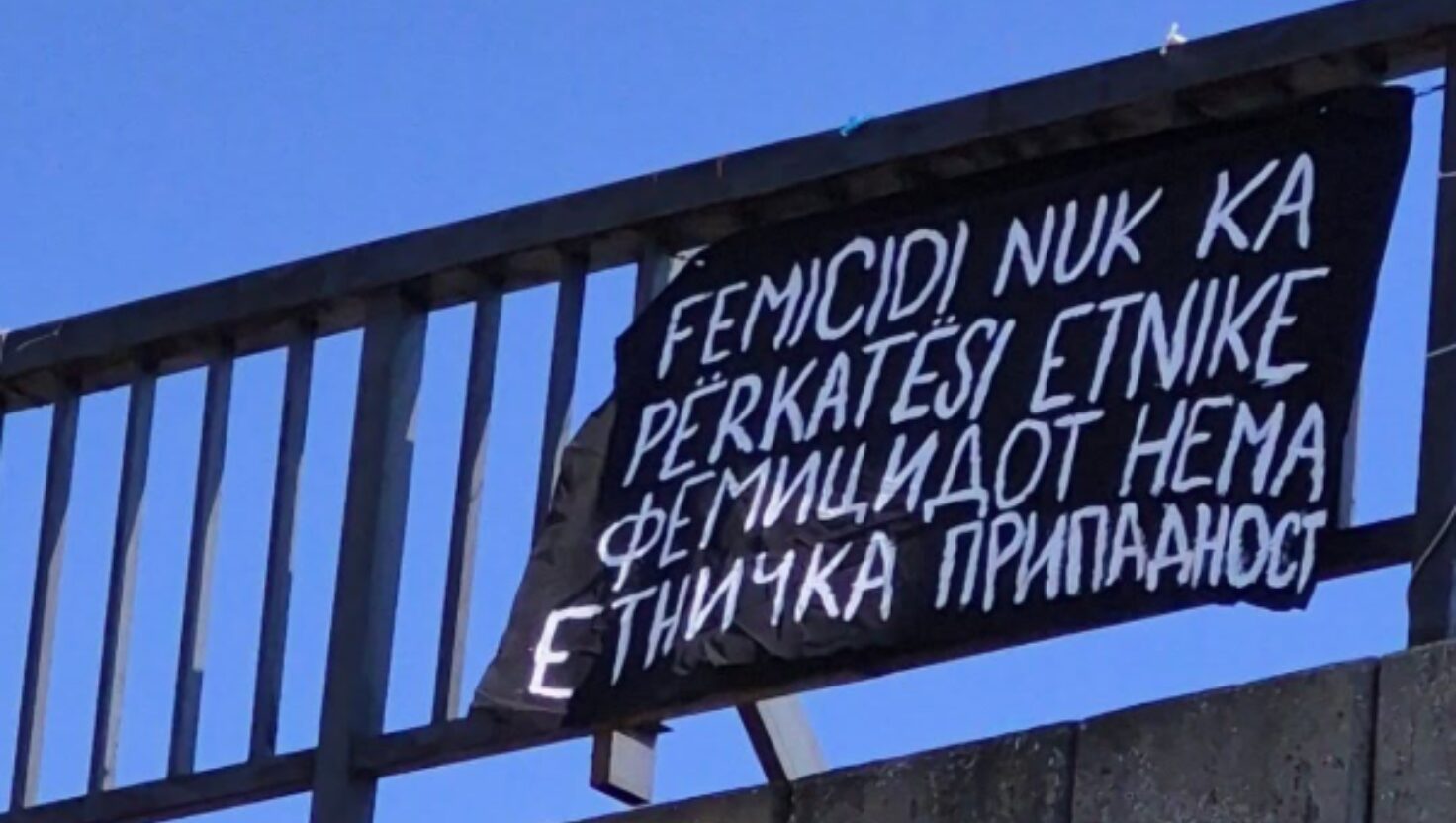
The calls for unity have also been carried through the Solidari.te initiative, which uses art and public messages to address social problems that affect citizens regardless of their background. “Femicide has no ethnicity,” reads a banner put up in Tetovo. Another poster expresses anger that murdered women are often remembered with flowers instead of being given justice: “I don’t want a rose, I want justice for the murdered sisters.”
Protests in Kosovo too after the killing of Arlinda Zekaj
Killings of women remain a problem in Kosovo as well. According to Kosovo Police, 62 women were registered as victims of killings within the family between 2010 and August 2026. A week after the killing of Arlinda Zekaj, who had reported the violence beforehand, 11 police officers, the chief prosecutor, a prosecutor and a domestic violence coordinator have been suspended. The director general of the police has resigned, an inquiry committee has been set up in the Assembly to look into the case, and protests continue in several cities. In North Macedonia, a week after the killing of Biljana Kiriq, who had also reported the violence beforehand, there have been no resignations or suspensions.
Read these too:
- Ministria e Punëve të Brendshme nuk ka të dhëna për dhunuesit që shkelin masat e përkohshme kundër dhunës
- Dhuna ndaj grave: A ka nevojë Maqedonia e Veriut për hallkat elektronike?
- North Macedonia among the countries with the highest number of femicides; for MPs, the strategy against violence is not a priority