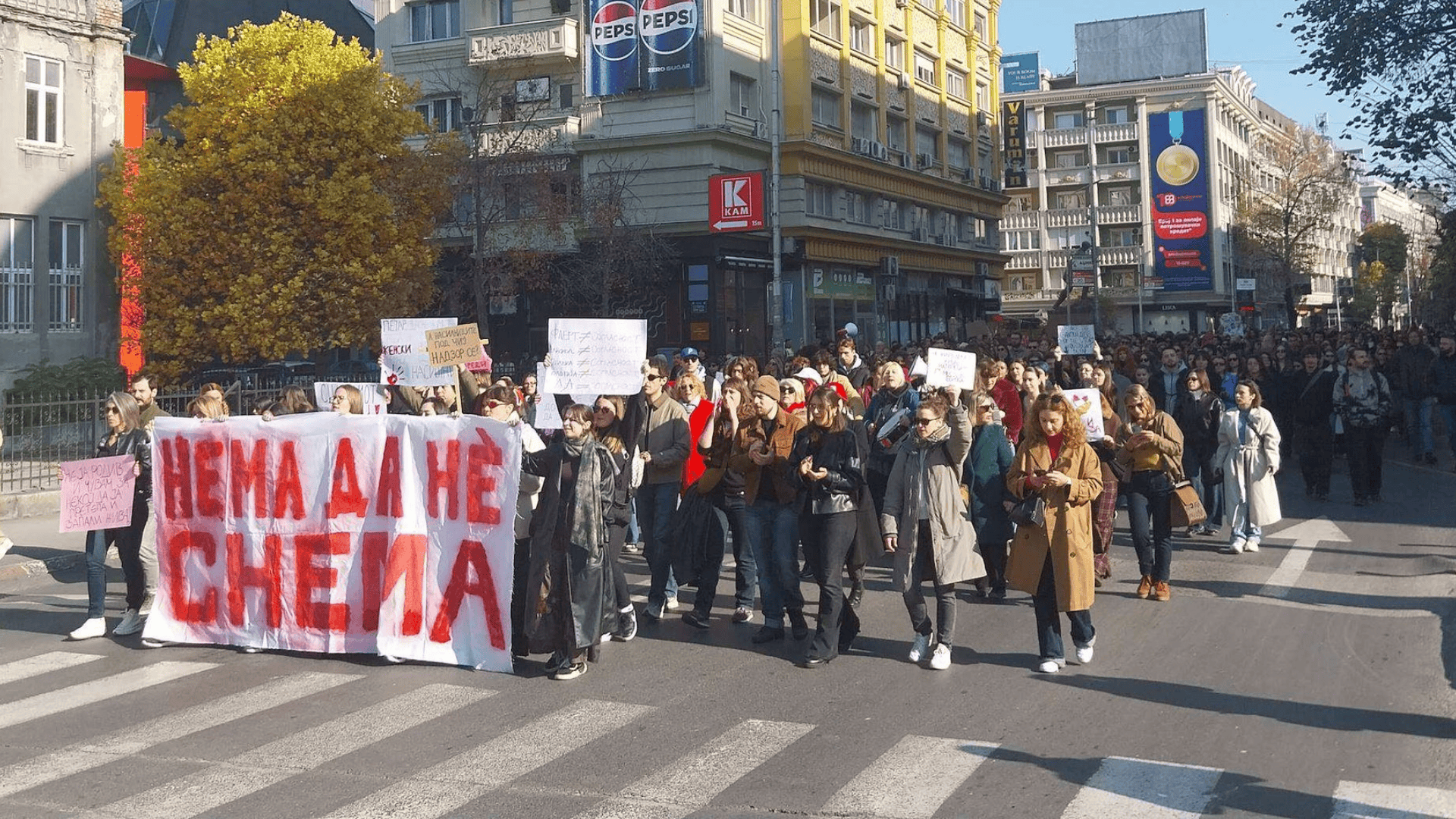
Citizens and activists marched in Skopje against femicide and violence against women, demanding accountability for institutional failures to protect women and girls. The protest was sparked by the murder of 17-year-old Biljana Kiriq from Bogdanci.
The march was organised by the informal initiative “Not One More!”. It started at Woman Warrior Park in central Skopje, passed the Assembly and the Ministry of Justice, and ended in front of the Ministry of Education and Science.
“You will not make us disappear”
Protesters carried banners against violence. The march was led by the message “You will not make us disappear.”
Biljana Kiriq was killed, and her body was found in the trunk of a burned vehicle. The case caused strong reactions and reopened the debate on the responsibility of institutions to protect victims of violence.
Elena Petrova, who took part in the protest, said the abuser had a history of violence.
“When a girl asks for protection and is then killed, it is a matter of concrete responsibility. This is femicide. Every murder of a woman is more than an act of violence. It reflects a much deeper failure of our system,” she said.
The organisers and protesters demanded that responsibility be established and that sanctions be imposed for all institutional failures. They called for urgent legal changes to protect people from violence, and for gender and gender equality to be restored in laws, programmes and education.
They also demanded the dismissal of public officials who justify violence against women or present women’s submission as normal.
Petrova added that “we cannot fight gender-based violence while politically undermining the very basis for recognising it.”
Outside the Ministry of Justice, protesters whistled and chanted against violence and institutional inaction.
A woman from Bogdanci accused teachers and the police of knowing about the violence against Biljana but failing to step in to protect her. According to her, the girl had been missing from school for weeks, and the violence had been reported to the police several times.
“The violence had been reported to the police several times, once even a month before the girl was killed. My brother and his friends protected her from him until the police arrived, but then the police released him straight away and he later killed her,” she said.
Alarming figures on femicide
Femicide and violence against women remain serious problems in North Macedonia. According to data for the period from 2021 to 2025, 26 women were killed in the country, nine of them in 2023. According to Eurostat, that year the country had one of the highest rates of killings of women in Europe, at six cases per million inhabitants.
The Criminal Code does not explicitly mention the term femicide. However, the 2023 amendment to Article 123 provides for punishment for the killing of a woman or girl as a result of gender-based violence.
Kosovo also protests after the killing of Arlinda Zekaj
The alarm over the killing of women has also been raised recently in Kosovo. A few days ago, protests were held in Pristina demanding institutional accountability after the killing of Arlinda Zekaj. She is suspected of having been killed with an axe by her brother-in-law on 25 October.
Arlinda had repeatedly sought institutional protection from violence and threats. Just days before she was killed, she had told the Prosecutor’s Office that her life was in danger. The case also sparked protests in other cities in Kosovo.
According to Kosovo Police, 62 women were registered as victims of killings within the family from 2010 to August 2026.
Read these too:
- Ministria e Punëve të Brendshme nuk ka të dhëna për dhunuesit që shkelin masat e përkohshme kundër dhunës
- Dhuna ndaj grave: A ka nevojë Maqedonia e Veriut për hallkat elektronike?
- North Macedonia among the countries with the highest number of femicides; for MPs, the strategy against violence is not a priority