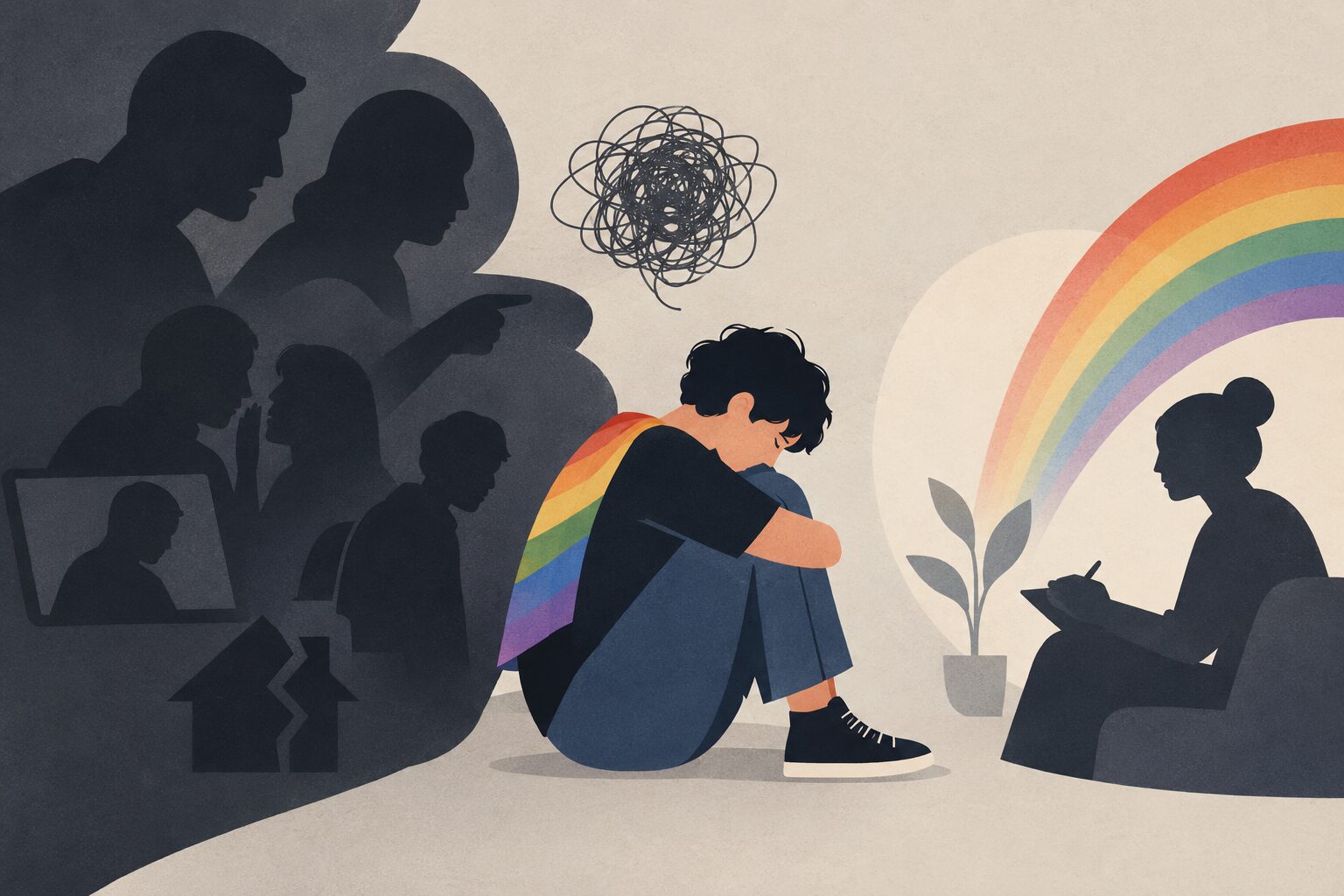
LGBTI+ people remain among the most vulnerable groups when it comes to mental health.
Every day, many of them carry a weight that few people ever see: anxiety, depression, the marks of trauma, internalized shame, and the endless stress of hiding who they really are.
Findings from the psychological sessions held by the Center for Equality and Liberty of the LGBT Community (CEL), based in Kosovo, throughout 2025, show exactly that. Rejection by family, discrimination at school and at work, isolation, online harassment, violence, and the uncertainty of having a safe place to live are realities that keep repeating themselves.
To understand what these experiences leave behind, we spoke with the staff at this center, which offers free psychological sessions to members of the community.
Rejection, stigma, and the fear of being outed leave deep marks on mental health. But according to them, professional help alone isn't enough, society itself needs to change too.
How society treats them, and the toll it takes on mental health
The way society treats LGBTQI+ people directly affects their sense of safety and belonging. CEL Kosovo explains that even when someone isn't dealing with an open incident of discrimination every day, simply expecting to be rejected can create a constant state of distress.
At home, at school, at work, or within institutions, the fear of how others will react can shape how a person behaves, communicates, and builds relationships.
CEL Kosovo's data on 132 people who used its psychological services show that anxiety was the most commonly reported internal struggle, at 24.7 percent. Stress followed at 12.9 percent, and depression at 12.1 percent.
“Sexual orientation or gender identity aren't the cause of these struggles, what matters is the environment in which the person is trying to feel safe and accepted,", says CEL Kosovo.
They point out that this data reflects only the people who have used the organization's services and shouldn't be read as representing all LGBTQI+ people in Kosovo.
Family rejection can threaten housing and safety too
One factor CEL Kosovo singles out is family rejection. When the family is at the same time the main source of emotional support, financial support, and housing, rejection can carry consequences that reach far beyond the family conflict itself.
According to the organization's first report, family problems accounted for 23.1 percent of the documented external difficulties. In the report covering December 2024 to December 2025, that figure stood at 23.9 percent.
“Ongoing stigma can make a person doubt themselves, expect judgment even in new relationships, and withdraw from others just to protect themselves,"explains CEL Kosovo.
In cases where discrimination is also experienced within institutions, they say, a person can lose faith that help will be safe and confidential. This can push them not to seek help at all.
In some cases documented by the organization's psychological services, self-harm and suicidal thoughts have also come up, situations that, according to CEL Kosovo, call for immediate assessment and support.
Why does the stigma persist?
For CEL Kosovo, there's no single explanation for how Albanian-speaking societies, and Balkan societies more broadly, view sexual and gender diversity. In Kosovo's context, rigid gender role norms, expectations around marriage and family, fear of judgment, and a lack of information can all shape these attitudes.
These attitudes, the organization says, can be learned and reinforced within families, schools, the media, and public debate.
Still, CEL Kosovo stresses that these attitudes don't necessarily represent all of society, and that they can change.
“Our reports show the consequences that rejection and stigma have for people seeking support, but they don't directly measure why the general population holds certain attitudes,"CEL Kosovo clarifies.
That's why they see education, dialogue, and institutional accountability as important parts of changing this.
Hiding your identity as a safety strategy
For some LGBTI+ people, not disclosing their sexual orientation or gender identity isn't simply a private matter. It can be a way of avoiding rejection, violence, or losing their home.
But this kind of hiding can come with a psychological cost. The person constantly has to think about what they can say, how they should behave, and who they can trust.
“Constantly weighing what you can say, how to behave, and who you can trust takes a huge amount of emotional energy,", says CEL Kosovo.
According to them, this can limit close relationships and add to anxiety, loneliness, internalized shame, and the feeling that a person can't freely plan their own future.
In CEL Kosovo's first report, issues related to coming out made up 20.4 percent of the documented external difficulties.
“From a psychological standpoint, the effects can build up over time when a person lives for a long stretch with the fear of rejection."“.
Therapy alone can't solve the problem
Professional psychological support can help people process experiences of rejection or violence, manage anxiety, and rebuild self-confidence. But CEL Kosovo stresses that therapy alone can't undo the harm caused by an exclusionary environment.
That's why, according to the organization, what's needed is trained healthcare professionals and public workers, effective protection against discrimination, safer schools, support for families, and spaces where LGBTQI+ people can seek help without fearing their identity will be exposed.
“The approach needs to be confidential, accepting, and trauma-informed,"CEL Kosovo stresses.
According to them, an open society can't stop at statements. It has to include changes that LGBTI+ people can actually feel in their everyday lives, at home, at school, at work, within institutions, and in access to services.
This publication was produced within the framework of the project Queer and Present: Media, Rights and Safety for LGBTIQ+ persons in Pollog, which is implemented as part of the broader regional project Together for LGBTQI+ Equality, implemented by the Centre for Civic Education (CCE) in partnership with ERA – LGBTI Equal Rights Association for the Western Balkans and Turkey, Queer Montenegro, Queer Center Skopje, Tuzla Open Center, Open Mind Spectrum Albania (OMSA), and the Center for Social Group Development from Kosovo. The programme is funded by the European Union.

The contents of this publication are the sole responsibility of the Center for Equal Opportunities “Mollekuqja” and do not necessarily reflect the views of the European Union, CCE, or the project partners.