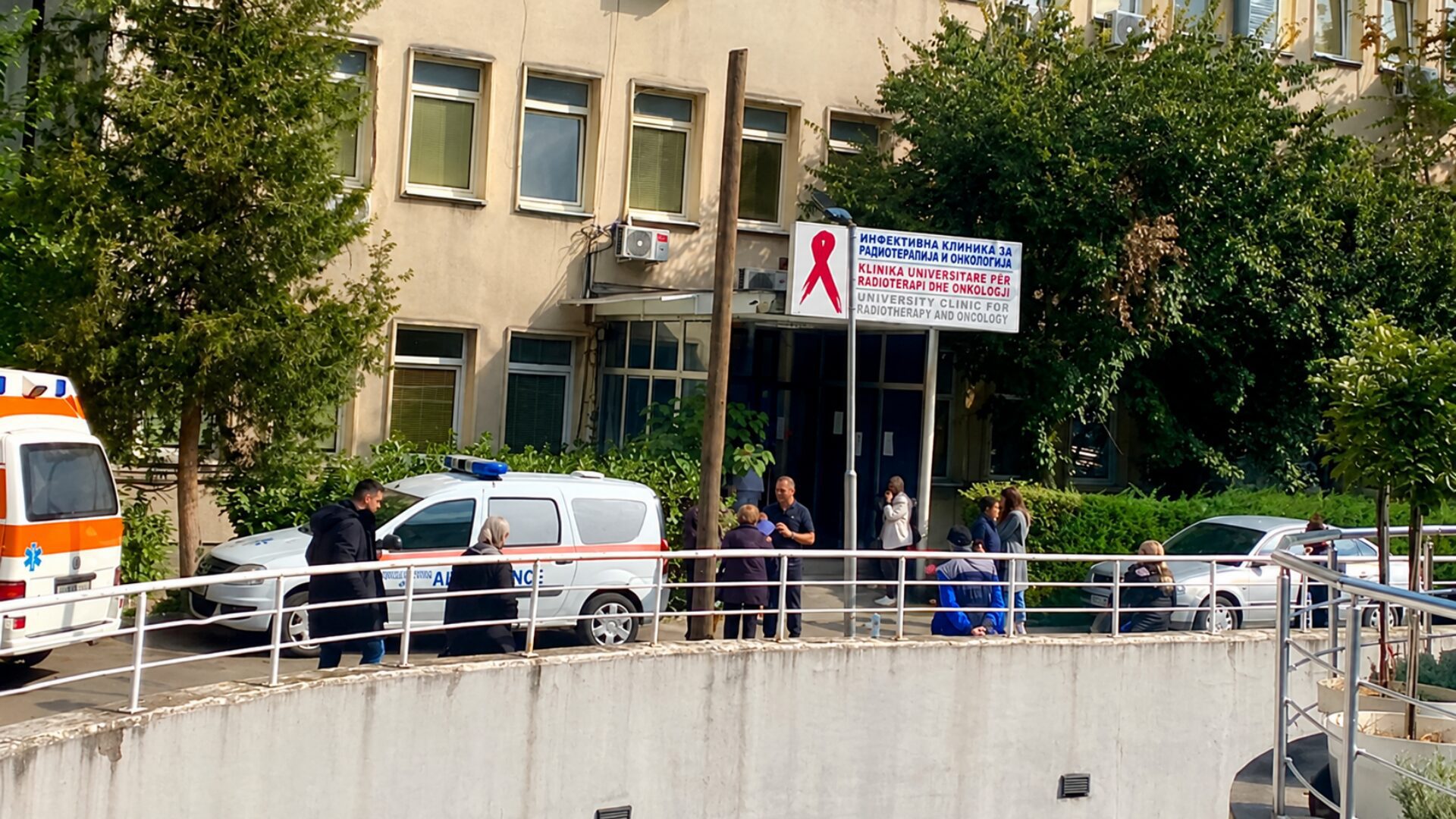
A thousand patients were diagnosed with breast cancer last year in North Macedonia, while around seven thousand oncology patients are currently in active treatment at the Clinic of Radiotherapy and Oncology in Skopje. But behind the numbers and the Pink October campaigns lie problems that have gone unresolved for years: hours-long waits for therapy, staff shortages, services concentrated in Skopje, and screening that reaches only a small share of women. Mollëkuqja brings a look at the main challenges facing cancer patients and the gaps in the system.
October is the month when breast cancer gets talked about most around the world. The color pink appears in campaigns, institutions, and on social media, while women are urged to look after their health and get checked.
Despite awareness campaigns, the healthcare system deals with problems every day that can’t be solved by awareness alone.
A thousand patients were diagnosed with breast cancer last year alone. Meanwhile, around 7,000 oncology patients are currently being treated at the Clinic of Radiotherapy and Oncology in Skopje.
For many of them, the fight against the disease comes with another battle: getting to the examination, the diagnosis, and the therapy on time.
Hours of waiting for therapy
The hallways of the Oncology Clinic fill up from the early morning hours. Patients wait for check-ups, therapy, and other procedures, and for some of them, the day at the clinic stretches into the afternoon.
One patient told Mollëkuqja that even though she has finished her treatments and now only comes in for check-ups, appointment days still bring on anxiety because of the chaos and the long waits.
“I’ve finished my treatment, now I just have a few check-ups a month, but I go early in the morning, at 7, hand in my booklet to get in line, and then I get called into the examination room sometime around 10 or 11. Sometimes even later. Last time, two women fainted. There needs to be a more sustainable solution,” she said.
The problem isn’t just the number of patients. Oncology services are still concentrated in Skopje, while decentralization, something that’s been talked about for years, is moving slowly.
The State Audit Office called for services to be spread out
The need to spread out oncology services isn’t just something patients or non-governmental organizations are asking for.
The State Audit Office has found that the Ministry of Health needs to bring in more capacity at public health institutions that are equipped to treat oncology patients.
Decentralization could ease the burden on the Oncology Clinic in Skopje and cut down waiting times for patients, especially those coming from other cities.
That’s exactly what patients are asking for too.
Ana Marjanoviq from the Hema-onko Association says they’ve pushed for decentralization to happen in a way that, above all, gives patients safe therapy and the conditions to receive it regularly, on time, and in an environment they deserve.
“The goal isn’t just getting the therapy, it’s making sure that every patient who won’t be at the Oncology Clinic can still receive this therapy safely. As patients, we know better than anyone how much pressure there is at the Oncology Clinic,” Marjanoviq said.
Decentralization has started, but it’s still a work in progress
The director of the Clinic of Radiotherapy and Oncology in Skopje, Igor Stojkovski, says decentralization is planned in several phases.
The first phase has already begun at the “8 Shtatori” City General Hospital in Skopje, through specialist consultation services. There are plans to eventually include the hospitals in Bitola and Shtip as well.
“The first phase has started, which covers specialist consultation work. We’re hoping the day hospital will also start operating next year. So this is happening in several phases. It depends on the hospitals’ infrastructure. The priority is making sure patient safety is adequate. That means that, along with proper staff and infrastructure, therapy needs to be something patients can receive safely. Is it a problem? Yes, it is, you can see that for yourself,” Stojkovski said.
But the problem starts long before a patient ever reaches the Oncology Clinic.
Screening isn’t catching the disease in time
Early detection remains one of the weakest links. Check-ups meant to catch breast cancer before it progresses aren’t reaching the coverage they need to. The State Audit has found that breast cancer screening coverage ranges from just 0.8 to 5.4 percent.
These figures fall far short of the coverage needed for screening to have any real effect at the population level.
The consequences show up later, in treatment. According to the data presented, around 80 percent of patients begin treatment once the disease has already reached an advanced stage.
Radiologist Argjend Imeri has said the problem is that screening exists more on paper than in women’s actual lives.
“This is exactly the point of screening: not to diagnose the disease once it’s already visible, but to catch it before it has time to become more dangerous.”
According to him, the state needs to provide sustainable funding and treat screening as an ongoing process, not a seasonal campaign.
“Screening can’t be a seasonal project that gets more visible in October and gets forgotten the rest of the year. Cancer doesn’t have an awareness month. It shows up every day of the year,” the radiologist said.
He says the message to women needs to be clear: mammograms aren’t only for when symptoms show up.
“You get one precisely when you don’t have symptoms. The absence of those signs is not a reason to skip a routine check-up,” Imeri said.
The Ministry says it’s working on a new model
Despite criticism from doctors, patients, and the Audit Office, the Ministry of Health says it’s working on changing how screening is organized.
The Ministry has announced that it has recently been developing a more organized, population-based model, with wider reach and better tracking of patients throughout the entire process.
“We’re working on new and improved forms for reporting malignant diseases, which should allow for better quality, more structured case registration and link them to the national health information system,” the Ministry said.
According to them, the data is expected to gradually be integrated with the digital platforms “Termini im,” “Shëndeti im,” and “skrining.mk,” so that a patient can be tracked from the moment of the screening invitation all the way through the mammogram, the result, the diagnosis, and the treatment.
While institutions talk about a model that’s supposed to work better in the future, women who need a diagnosis and treatment today are dealing with a system that still isn’t fully meeting their needs.
Despite the setbacks, activists keep up the fight for awareness
In this situation, part of the burden still falls on patient organizations and civil society, who have spent years trying to convince women to make preventive check-ups part of their routine.
The head of the Ezra Association, Liridona Beqiri, says that care has to start with personal awareness, but it can’t stop there.
“Our campaigns are always about raising awareness among the public, because taking care of your health absolutely has to start with personal awareness, and then move on to self-exams and preventive check-ups, which should be part of our everyday care, part of our health culture. Unfortunately, we still haven’t reached the level we keep pushing for with our campaigns,” Beqiri said.
She says breast cancer isn’t limited to any one group and that the disease is affecting younger women too.
Still, women’s awareness can’t take the place of a system that actually works. A woman can be informed, ask for a check-up, and be ready for treatment, but she’s still left facing the same questions: how soon she’ll get an appointment, how long she’ll wait for an exam, when she’ll get her diagnosis, and how far she’ll have to travel for therapy.
This publication was produced within the framework of the project Queer and Present: Media, Rights and Safety for LGBTIQ+ persons in Pollog, which is implemented as part of the broader regional project Together for LGBTQI+ Equality, implemented by the Centre for Civic Education (CCE) in partnership with ERA – LGBTI Equal Rights Association for the Western Balkans and Turkey, Queer Montenegro, Queer Center Skopje, Tuzla Open Center, Open Mind Spectrum Albania (OMSA), and the Center for Social Group Development from Kosovo. The programme is funded by the European Union.

The contents of this publication are the sole responsibility of the Center for Equal Opportunities “Mollekuqja” and do not necessarily reflect the views of the European Union, CCE, or the project partners.